


PROFESSOR J
Oct 30, 2026
Slaveholders offered hefty bounties for the barefoot runaways – we may never know if they made it to freedom
SETH ROCKMAN SOUNDED PRETTY CERTAIN when he claimed recently that footwear played an indispensable role in Black people’s quest for freedom in the antebellum South.
“You can take a fairly mundane material artifact like the shoe, and connect it to the larger political project of enslaved people's quest for liberation,” Rockman, a Brown University history professor, said during an August 2026 speech at the Charles River Museum of Industry & Innovation in Waltham, Massachusetts.
“The shoe is crucial in this regard,” Rockman said. “For example, no one is able to run away to the North without shoes.
“People who in fact come across the Mason-Dixon line and escape to freedom often say, ‘I couldn't have done it without footwear,’” Rockman continued. “No one is on the record of having made it without shoes.”
In order to accept Rockman's claim as fact, one would have to ignore the dozens of cases in which enslaved people in the antebellum South didn’t wait for footwear in order to take flight.
Those cases are not hard to find. They’re located in an online database called “Freedom on the Move.”
By entering terms such as “bare foot,” “barefoot,” and “without shoes” in the search field for the Freedom on the Move database, Sneaker Theory discovered dozens of ads in which slaveholders describe runaways as having been barefoot at the time of their escape.

Beyond the newspaper ads for barefoot fugitives, Rockman’s claim is further undermined by a passage from “Narrative of the life of J.D. Green, a runaway slave, from Kentucky: containing an account of his three escapes, in 1839, 1846, and 1848.”
In that narrative, Green speaks of a harrowing encounter in which he was without shoes when he made it from Maryland to a farmhouse during an escape on his way to Chester, Pennsylvania, and ultimately to freedom, albeit a short-lived freedom for reasons that go beyond his lack of footwear.
In light of J.D. Green’s account, and unless each and every barefoot freedom seeker mentioned in the runaway ads was recaptured, the claim that “no one is on record” of having successfully run away to the North without shoes is flawed, faulty, and false. At a minimum, it warrants further investigation.
But before we address whether any freedom seekers mentioned in the runaway ads made it to the North without shoes, let’s examine what the ads actually stated.
Detailed descriptions and cash rewards
Although more than a dozen ads placed in the mid- to late 1700s described the fugitives as barefoot, those cases are being excluded here because they involved northern states, such as New York, where slavery was still permitted at the time, and thus do not refute Rockman’s claim that enslaved people could not run away “to the North” without footwear – the reason being is that in these particular cases, enslaved individuals were already in the North when they escaped.
The known cases that potentially undermine Rockman’s claim begin in the 1800s and involve newspaper ads in the South, namely, Virginia and North Carolina. There could be more ads for fugitives who fled without footwear located in other databases. For the purpose of this article, Sneaker Theory only examined those ads found in Freedom on the Move.

Here are the relevant excerpts from ads in which fugitives were described as barefoot at the time of their escape:
In an April 23, 1808 ad placed in the Raleigh Register, Samuel Cook offered a $20 reward for the return of “a Negro fellow named GEORGE, about five feet ten inches high, twenty three years old. he had on when he went off, a Negro cotton short coat and overalls, old hat, and was barefooted.” (The term “Negro cotton” or “Negro cloth” is something that Rockman illuminates in his 2024 book, “Plantation Goods: A Material History of American Slavery.”
In a May 9, 1809 ad placed in the Virginia Argus, Samuel Grimshaw offered a $6 reward for the return of “A Negro Man, named BOB ABOUT 20 years of age, 5 feet 11 inches high, slender made, black complexion, had on when he went away, negro cotton waistcoat and breeches, barefooted, ragged, his toes next his big toes are the longest.”
In a May 25, 1812 ad placed in the Edenton Gazette And North Carolina General Advertiser, Micajah Bunch offered a $30 reward for the return of “my negro man TOM, formerly the property of Thomas W. Thompson, of this County. He is about 5 feet 9 or 10 inches high, of a light complexion, his toes very scraggy, as much so that when barefoot, his track is very not able.” (We concede that Tom may or may not have had shoes at the time of his escape).
In a June 27, 1822 ad placed in the Raleigh Register And North Carolina Weekly Advertiser, John M’aden offered a $20 reward for “a bright Mulatto Man named JERRY. He is about 24 years of age, near 6 feet high, a stout, bony fellow, thick red lips, dark red cheeks, freckled face, brown coarse hair, rather straight, stoop-shouldered, rocks as he walks, and he has a very downcast look when addressed. He will be easily confounded if closely questioned. He had on a pair of homespun dark brown woollen and cotton pantaloons, an old cambric shirt, an old hat, and was barefooted … he left me without any known cause or previous preparation.”
In a May 25, 1826 ad placed in the Star And North Carolina State Gazette, Berry Tipper offered a “liberal reward” for the return of “a negro woman by the name of BET. When she went off, she had on a homespun coperas[sic] frock, and carried two other frocks, with her, one a blue striped homespun, the other a red flowered Calico, she was barefoot, and without a bonnet on her head. She is between twenty five and thirty years of age, dark complected, common size, rather fleshy, teeth remarkably white, a scar on one side of her neck, occasioned by a whip.”
In a August 26, 1829 ad placed in the Halifax Minerva, of Halifax, North Carolina, William B. Moore offered a $10 reward for the return of “a negro woman named CRELCY. She is between 25 and 27 years of age, tolerably black, about 5 feet high, has a down look, a week[sic] voice, and is round shouldered. She is in a bad state of health, being either pregnant or otherwise swelled. She was barefooted and had on white cotton clothes.”
In a June 7, 1836 ad placed in the Greensborough Patriot, John W. McGehee offered a $50 reward for the return of “Two negro men, Solomon and Abram, Solomon is a man twenty years old--black complexion; full face; large mouth; thick lips; coarse voice, large feet; with a burn on his back, received when small--six feet high--well made, --smiles when spoken to,--took with him a cloak and frock cloth coat, velvet collar. Abram is about five feet six inches high; black complexion; pert when spoken to; strait[sic], well made man; 26 or 7 years of age; small feet,--fine voice; had on janes coat, worne little; bare footed.”
In a January 27, 1864 ad in the Greenborough Patriot, Obed Mcmichael offered a $25 reward for the return of “a negro boy named CALVIN, aged 11 1/2 years, well grown for one of his age, very black, barefoot when he left, wore away a man’s shirt, the sleeves which were ‘tucked,’ a blue cloth military cap, coat a good deal worn … In all probability he is lurking along the line of the N.C. Railroad, and may possibly endeavor to procure a passage on the train.”
In a June 12, 1864 ad placed in the Daily Progress, of Raleigh, North Carolina, C.P. Culver offered a $500 reward for the return of “THREE NEGRO BOYS, the eldest, JIM, is 23 years of age, five feet eight or ten inches high, of a copper color, a bold, impudent, swaggering air; had on when he left a black wool hat, dark copperas-colored cotton pants, old dark plaid cassimere coat, new shirt and a pair of boots. TOM, sixteen years of age, light copper color, five feet five or six inches high, sharp featured, quite intelligent and having been with the army, has something of a military air in his address; had on when he left, a black slouch hat, gray roundabout, white woolen pants well worn, new shirt and was either bare-footed or had on a very inferior pair of shoes. Albert, eighteen years of age, ebony color, stout built, five feet four or five inches high, had on when he left, an old black slouch hat, new shirt, blue navy cloth pants well worn, barefooted and rather of a sullen look. These negroes were purchased a few weeks since in Augusta, Ga. Jim and Tom having been connected with the army, are evidently endeavoring to either make their way to the army of Virginia, or to get within the Yankee lines.”
In a June 15, 1864 ad placed in the Daily Southern Citizen, in Greensboro, North Carolina, Peter Kirkman, acting on behalf of a “Mr. Simmons,” offered a $25 reward for the return of “a negro boy about 22 years of age, about five feet, 6 or 8 inches high, black complexion round face, stutters somewhat when spoken to, especially when a little excited, had on when he left a pair of pants made of jeans, cotton, no vest or coat, and barefoot.”
Evidence of successful escapes elusive
A plain reading of these ads shows that not all enslaved people waited on footwear to put their escape plans into effect. The deeper question, however, is whether they actually made it to freedom in the North – something for which Rockman claims there is no evidence.
It is notable that among the ads we discovered for barefoot runaways, none were placed in newspapers in the Deep South, such as Mississippi or Alabama. Geography – and more specifically, proximity to the free territory of the North – was a major factor in whether an enslaved person’s escape was permanent or temporary.
As noted in a TIME magazine article written by James C. Cobb, a history professor emeritus at the University of Georgia and also a former president of the Southern Historical Association, it was “no mere coincidence” that Frederick Douglass and Henry Highland Garnet – runaways who became luminaries in the movement for abolition – had made their escapes from Maryland.
Historians, Cobb wrote, have shown that “the odds of permanent escape were so much greater in the border slave states that Delaware, Maryland and Missouri accounted for less than 6% of the total slave population of the slave states in 1850 but 36% of the runaways.”
Although Frederick Douglas is portrayed as a barefoot runaway on the sheet music cover for “The Fugitive’s Song,” in reality he escaped slavery while disguised as a free Black sailor.

The reality is fugitives from slavery faced daunting odds – with or without shoes – no matter what their starting point.
“Although the spectacular escapes depicted in slave narratives and abolitionist literature were not without their basis in fact, the great majority of runaways left neither dramatically nor in the end successfully,” history scholars John Hope Franklin and Loren Schweninger wrote in their 1999 book, “Runaway Slaves: Rebels on the Plantation.”
Complicating matters further is the fact that not all enslaved individuals sought to go to the North.
“While the bulk of scholarship has focused on those who fled to the northern states and outside of the country, the majority actually stayed within the South,” wrote Viola Franziska Müller, author of “Escape to the City,” a 2022 book that tells the stories of formerly enslaved men and women who found refuge in the “Southern” cities of Baltimore, Charleston, New Orleans, and Richmond.
Using a database of 2,260 runaway slave ads placed in South Carolina newspapers, Amani Marshall found that certain runaways were able to “pass as free” and that “the majority of runaways did not strike out for free territory. Instead, many remained in the South where they created free identities that enabled them to secure employment, enjoy mobility, and maintain kinship ties, if only temporarily.”
For these reasons and others, determining the fates of those listed in runaway slave ads would not be an easy undertaking. As stated on the website for the Freedom on the Move database, the runaway ads were “often the only surviving record of an individual’s life.” However, there could still be evidence that the barefoot runaways were recaptured or made it to freedom. Finding that evidence is at least partly a matter of resourcefulness and will.
The dangers of being barefoot
There were definitely risks associated with trying to escape slavery without the benefit of shoes.
One of the most well-known escapes – described in “Narrative of the life of J.D. Green, a runaway slave, from Kentucky” – contains a harrowing encounter in which Green – while on the run from a Maryland slaveholder – shows up barefoot and hungry at a farmhouse near Chester, Pennsylvania. There, Green wrote, one of the women inside “saw my feet, which were awful from what I had undergone, and asked me if I should not like to have a pair of shoes, and I said I should.”
What happened next simultaneously lends credence to Rockman’s argument that footwear was crucial, but also to our theory that footwear was not always a prerequisite for a successful escape. Wrote Green:
They went in search of a pair [of shoes] up the stairs, and I heard one say to the other, ‘He answers the description of a slave for which 200 dollars are offered.’ When they returned I was sitting still in the position I was in before they went up stairs. She said to the other, “I will go and see after the cows; and the other answered, ‘Don’t be long.’ But my suspicion was confirmed that going after the cows was only a pretence; and when I thought the other had got far enough away; I laid hold of the remaining one and tied her to the bedstead; went into the closet and took a leg of mutton, and other articles, such as bread and butter, and made my way out as quick as possible; and when I got out outside I rubbed my feet in some cow dung to prevent the scent of the bloodhounds, and took to the woods, where I found a sand hole, in which I remained all day. The night was dark, with a drizzling rain; being very fit for travelling, I started again on my journey, but being very cautious, I only managed about 24 miles that night. Towards morning I met with a black, who told me that to Chester, in Pennsylvania, was only twenty-six miles.
Green – moving on his cow dung-covered feet – ultimately made it Derby, Pennsylvania, outside of Philadelphia, and held a job there for three years before the business failed and he wound up in prison and ultimately back in slavery before escaping again.
Iconic photos show runaways without shoes
History has handed us at least two haunting photos from 1863 that show a formerly enslaved man and boy, respectively, who both arrived barefoot when they escaped to Union Army lines in Louisiana.
The first photo – on file at Yale University – is titled “Full length portrait, young boy standing, barefoot, clothes in tatters.” Another copy of the photo – this one said to be at Louisiana State University – is captioned: “600 Miles through swamp and cane brake to fight for freedom.” The photo of the boy – known as “Taylor” or “Contraband Jackson” – is often juxtaposed with a photo of him dressed as a drummer boy for the Union Army.

The second photo is part of package of photos of a formerly enslaved man named “Gordon,” who has also been referred to as “Whipped Peter.” Newspapers and abolitionists used the photo of Gordon’s severely scarred back – it is literally known as the "Scourged Back" photo – as a “visual testimony” of the horrors of slavery, writes David Pilgrim, founder of the Jim Crow Museum in Big Rapids, Michigan.
A lesser known photo that accompanied the “Scourged Back” photo – and the one that’s relevant for our footwear discussion here – shows Gordon barefoot when he entered Union lines before ultimately suiting up as a Union soldier.
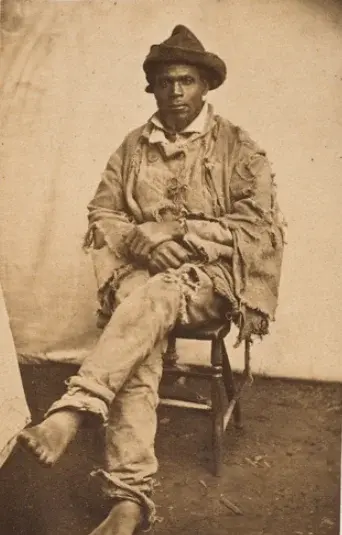

Gordon and Taylor may not have escaped “to the north” while barefoot, but they escaped slavery and reached Union Army lines in Louisiana while barefoot nonetheless.
Their stories – and the stories of J.D. Green, and Solomon and Abram, of Bet and the possibly pregnant or sick Crelcy, of the “bright mulatto” named Jerry and the “very black” boy named Calvin, and all the fugitives listed in newspaper ads for runaways and those whose names we’ll never know – serve as proof that the quest for Black freedom – while undeniably aided by access to shoes – wasn’t always contingent upon it
As painful as it is to imagine, the reality is “the record,” as Seth Rockman put it, is replete with vivid and compelling examples of fugitives who started their desperate journeys towards freedom with their only physical means and mode of transportation being the soles of their bare feet.
We may never know the precise number of individuals who permanently escaped the horrors of slavery in the U.S. without the benefit of shoes. But available evidence seems to show and suggest that the number is most certainly not zero.
Sneaker Theory reached out to Rockman via email for comment for this article but did not get a response.
Professor J is an amateur historian and the founding editor of Sneaker Theory, a website devoted to examining the role of footwear in society. As a journalist, his extensive body of work can be found under the byline Jamaal Abdul-Alim.